Tuesday, February 25, 2020

एक्सेल पर कैंडलस्टिक चार्ट कैसे बनाएं

एक्सेल पर कैंडलस्टिक चार्ट कैसे बनाएं

एक जापानी कैंडलस्टिक चार्ट एक वित्तीय उपकरण के दृश्य मूल्य प्रदर्शन का एक प्रकार है।
आमतौर पर चार्ट को एक लाइन के रूप में प्रदर्शित किया जाता है जो विभिन्न व्यापारिक सत्रों के समापन मूल्यों को जोड़ती है। इस प्रकार के प्रदर्शन का नुकसान यह है कि ट्रेडिंग सत्र के दौरान मूल्य के व्यवहार का कोई संकेत दिए बिना केवल सत्र का समापन मूल्य प्रदर्शित किया जाता है।
यह समस्या जापानी कैंडलस्टिक चार्ट द्वारा हल की गई है, जहां प्रत्येक ट्रेडिंग सत्र के लिए पूरे ट्रेडिंग सत्र में पूरे मूल्य व्यवहार की पहचान करना संभव है। विशेष रूप से, कम कीमत, उच्च कीमत, समापन मूल्य और उद्घाटन मूल्य दिखाए जाते हैं।
इस छोटे और सरल ट्यूटोरियल में आप सीखेंगे कि Microsoft Excel का उपयोग करके जापानी मोमबत्ती चार्ट कैसे बनाया जाए।
इस ट्यूटोरियल में मैंने मैक के लिए माइक्रोसॉफ्ट एक्सेल का उपयोग किया और मैंने 1 जनवरी 2020 से 21 फरवरी 2020 तक की कीमतों का उपयोग करके नेटफ्लिक्स (एनएफएलएक्स) कैंडलस्टिक चार्ट बनाया है।
TUTORIAL - 4 STEPS
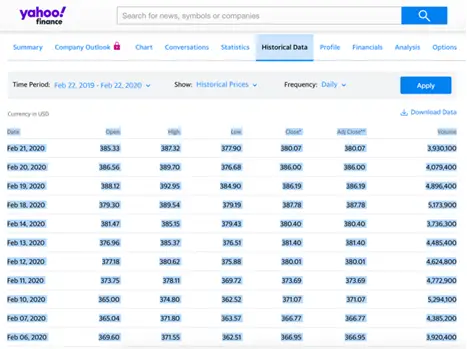
1) दिनांक 1 जनवरी, 2020 से 21 फरवरी, 2020 तक फ़िल्टर करें, फिर याहू फाइनेंस साइट से सीधे लिंक से उद्घाटन, समापन, कम और उच्च कीमतों को डाउनलोड करें या उन्हें एक एक्सेल स्प्रेडशीट में कॉपी और पेस्ट करें: https: // finance.yahoo.com/quote/NFLX/history?p=NFLX
एक्सेल
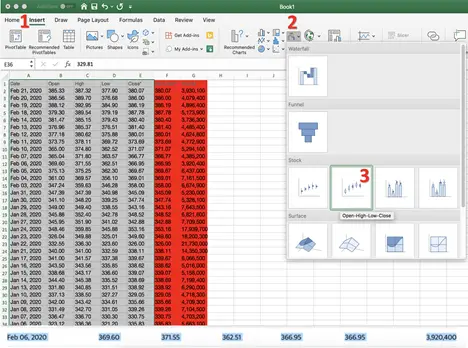
2) "दिनांक", "खुला", "उच्च", "निम्न", "बंद *" से संबंधित केवल कॉलम का चयन करें, अंतिम 2 की अनदेखी (लाल रंग में हाइलाइट) और कैंडलस्टिक चार्ट बनाने के लिए इस सरल प्रक्रिया का पालन करें:
  • "सम्मिलित करें" चुनें (बिंदु 1)
  • चार्ट का प्रकार "स्टॉक" (बिंदु 2) चुनें और 4 उपलब्ध चार्ट प्रकारों में से "ओपन-हाई-लो-क्लोज" चार्ट (पॉइंट 3) चुनें
एक्सेल
3) जो चार्ट आपको दिखाई देता है, वह नीचे की छवि जैसा होना चाहिए। जैसा कि आप देख सकते हैं, इस तथ्य के कारण ग्राफ पीछे की ओर है कि हमारी डेटा सीमा सबसे हाल ही में सबसे पुरानी से है। इसलिए हमें अंतिम चार्ट प्राप्त करने के लिए ये सरल उपाय करने होंगे:
  • उस बार पर डबल क्लिक करें जहाँ एकल दिन की तारीखें हैं (बिंदु 4)
  • दाईं ओर एक विंडो खुलेगी और आपको "रिवर्स ऑर्डर में श्रेणियाँ" पर क्लिक करना होगा (बिंदु 5)
यदि मूल्य स्केल मेरी छवि के अनुसार स्वचालित रूप से समायोजित नहीं होता है (न्यूनतम मूल्य के रूप में 300), लेकिन 0 से शुरू होता है, तो इस लेख के नीचे पढ़ें "अतिरिक्त" अनुभाग जहां मैं समझाता हूं कि पैमाने को कैसे समायोजित किया जाए।

एक्सेल
4) इस बिंदु पर आपके पास सही चार्ट होना चाहिए। डिफ़ॉल्ट मोमबत्तियाँ सफेद (तेजी) और काली (मंदी) हैं।
यदि आप जानना चाहते हैं कि हरे रंग की तेजी वाली मोमबत्तियाँ कैसे स्थापित करें और लाल रंग की मोमबत्तियाँ नीचे दिए गए अतिरिक्त खंड पर जाएँ।

एक्सेल
अतिरिक्त:
मोमबत्तियों का रंग (लाल और हरा) कैसे सेट करें
यदि आप मोमबत्तियों का रंग बदलना चाहते हैं तो इस सरल प्रक्रिया का पालन करें:
एक तेज मोमबत्ती (सफेद) (बिंदु 1) पर डबल क्लिक करें और खिड़की से जो आपके दाईं ओर खुलता है "रंग" (बिंदु 2) पर क्लिक करें और हरा (या एक जिसे आप पसंद करते हैं) चुनें। मंदी (काली) मोमबत्तियों के लिए उसी प्रक्रिया को दोहराएं और लाल रंग का चयन करें।

एक्सेल
चार्ट में मूल्य पैमाने को कैसे समायोजित करें
इस घटना में कि मूल्य पैमाने 0 से शुरू होता है, जिससे चार्ट को पढ़ना मुश्किल हो जाता है, निम्नलिखित सरल प्रक्रिया का पालन करें:
मूल्य पैमाने (बिंदु 1) पर डबल क्लिक करें और दाईं ओर खुलने वाली खिड़की से "प्रारूप अक्ष", सुनिश्चित करें कि आप "एक्सिस विकल्प" में हैं और "न्यूनतम" बॉक्स (बिंदु 2) में 300 का मान दर्ज करें।

एक्सेल
Newtraderu.com का अनुसरण करना जारी रखें क्योंकि जल्द ही आपको एक्सेल पर मूविंग एवरेज (और संबंधित क्रॉस) बनाने के तरीके पर एक मिनी-गाइड मिलेगा।

Sunday, February 23, 2020

Scientists Have Discovered a Brand New Electronic State of Matter

Scientists Have Discovered a Brand New Electronic State of Matter


Scientists have observed a new state of electronic matter on the quantum scale, one that forms when electrons clump together in transit, and it could advance our understanding and application of quantum physics.
Movement is key to this new quantum state. When electric current is applied to semiconductors or metals, the electrons inside usually travel slowly and somewhat haphazardly in one direction.

Not so in a special type of medium known as a ballistic conductor, where the movement is faster and more uniform.

The new study shows how in very thin ballistic conducting wires, electrons can gang up – creating a whole new quantum state of matter made solely from speeding electrons.

"Normally, electrons in semiconductors or metals move and scatter, and eventually drift in one direction if you apply a voltage," says physicist Jeremy Levy, from the University of Pittsburgh. "But in ballistic conductors the electrons move more like cars on a highway."

"The discovery we made shows that when electrons can be made to attract one another, they can form bunches of two, three, four and five electrons that literally behave like new types of particles, new forms of electronic matter."

Ballistic conductors can be used for stretching the boundaries of what's possible in electronics and classical physics, and the one used in this particular experiment was made from lanthanum aluminate and strontium titanate.
Interestingly, when the researchers measured the levels of conductance they found they followed one of the most well-known patterns in mathematics – Pascal's triangle. As conductance increased, it stepped up in a pattern that matches one of the rows of Pascal's triangle, following the order 1, 3, 6, 10 and so on.

"The discovery took us some time to understand but it was because we initially did not realise we were looking at particles made up of one electron, two electrons, three electrons and so forth," says Levy.
This clumping of electrons is similar to the way that quarks bind together to form neutrons and protons, according to the researchers. Electrons in superconductors can team up like this too, joining together in pairs to coordinate movement.
The findings may have something to teach us about quantum entanglement, which in turn is key to making progress with quantum computing and a super-secure, super-fast quantum internet.
According to Levy, it's another example of how we're reverse engineering the world based on what we've found from the discovery of the fundamentals of quantum physics – building on important work done in the last few decades.
"Now in the 21st century, we're looking at all the strange predictions of quantum physics and turning them around and using them," says Levy.
"When you talk about applications, we're thinking about quantum computing, quantum teleportation, quantum communications, quantum sensing – ideas that use the properties of the quantum nature of matter that were ignored before."
The research has been published in Science.

Beyond Harappa: The ‘Other’ Cultures (3000 BCE - 900 BCE)

Beyond Harappa: The ‘Other’ Cultures (3000 BCE - 900 BCE)

In the midst of a patchwork of small farms growing wheat, mustard and sugarcane, in turns, you will find one of the most talked-about excavation sites of the subcontinent in recent times. In 2018, archaeologists excavating at Sanauli, about 70 km from Delhi, in Western Uttar Pradesh, dug up a necropolis or cemetery with burials of what seemed to be a clan of warriors – sword-wielding men and women, who were buried with their weapons, wore helmets, ornate armour and even rode chariots.
Nothing like this had been found before, and what was really astonishing was the time period in which this clan lived. According to Carbon-14 dating, this necropolis went back to around 2200 BCE, making the warriors of Sanauli contemporaries of the Harappans, who were residing further west.
This was significant because it was unprecedented.
This discovery set the proverbial cat among the pigeons as it questioned many earlier points of view. It also raised a storm, with some sections equating this evidence of warriors with the period of the epic Mahabharata. That aside, what was significant was the fact that Sanauli opened up another chapter in the tantalising tale of the many settlements (or ‘cultures’, as described by archaeologists) that co-existed with the Harappan world across the Indian subcontinent.
But before we discuss that, it is important to know that there were many settlements that even predated Harappa. For instance, the earliest-known remnants of the first farmers in South Asia come from the 8000 BCE site of Mehrgarh in present-day Pakistan. This precedes Harappan civilisation by at least 5,000 years, and Mehrgarh isn’t the only one. There were many other Neolithic sites that demonstrate the shift from food gathering to food cultivation and animal domestication, like that of Lahuradewa (6500 BCE) in Uttar Pradesh and Sothi (4600 BCE) in Rajasthan.

History of India - 2000 years

Beyond Harappa: The ‘Other’ Cultures (3000 BCE - 900 BCE)

In the midst of a patchwork of small farms growing wheat, mustard and sugarcane, in turns, you will find one of the most talked-about excavation sites of the subcontinent in recent times. In 2018, archaeologists excavating at Sanauli, about 70 km from Delhi, in Western Uttar Pradesh, dug up a necropolis or cemetery with burials of what seemed to be a clan of warriors – sword-wielding men and women, who were buried with their weapons, wore helmets, ornate armour and even rode chariots.
Nothing like this had been found before, and what was really astonishing was the time period in which this clan lived. According to Carbon-14 dating, this necropolis went back to around 2200 BCE, making the warriors of Sanauli contemporaries of the Harappans, who were residing further west.
This was significant because it was unprecedented.
This discovery set the proverbial cat among the pigeons as it questioned many earlier points of view. It also raised a storm, with some sections equating this evidence of warriors with the period of the epic Mahabharata. That aside, what was significant was the fact that Sanauli opened up another chapter in the tantalising tale of the many settlements (or ‘cultures’, as described by archaeologists) that co-existed with the Harappan world across the Indian subcontinent.
But before we discuss that, it is important to know that there were many settlements that even predated Harappa. For instance, the earliest-known remnants of the first farmers in South Asia come from the 8000 BCE site of Mehrgarh in present-day Pakistan. This precedes Harappan civilisation by at least 5,000 years, and Mehrgarh isn’t the only one. There were many other Neolithic sites that demonstrate the shift from food gathering to food cultivation and animal domestication, like that of Lahuradewa (6500 BCE) in Uttar Pradesh and Sothi (4600 BCE) in Rajasthan.
The other Chalcolithic cultures
While the Harappan Civilisation, which rose and fell between 3000 BCE and 1700 BCE, dominates any conversation about the beginnings of ancient history, what rarely finds mention is that our land was populated by a whole range of other communities or cultures, each of which had their own unique and independent identity. Some of them even endured till much after the Harappans had moved on.
Most of these ‘other’ cultures, categorised as ‘Chalcolithic’ cultures (marked by the use of copper for the first time by man), were concentrated in the areas of present-day Rajasthan, Central India and the Deccan. And they had strong trade links with each other.
It was a diverse and well-networked world.
AHAR-BANAS CULTURE (3000 – 1900 BCE), South-Eastern Rajasthan
This is among the earliest Chalcolithic cultures of India, with more than 100 sites, mostly along the Banas River valley that flows in Rajasthan and is a tributary of the Chambal River further east. This culture, like the general norm, was named after the site of ‘Ahar’, where it was first discovered.
Important sites of the Ahar culture
अहार संस्कृति के महत्वपूर्ण स्थल
Ahar, in Udaipur district, was excavated in 1961-62 by archaeologist H D Sankalia and his team, who found evidence of a fully developed agro-pastoral culture. There were signs of rice cultivation and domestication of animals through the bones of cattle, sheep, goats and dogs, among others.
Other important sites of this culture are Gilund in Rajsamand district and Balathal in Udaipur district. Gilund was excavated by B B Lal (ex-DG, ASI) and Balathal by V N Misra (ex-Director, Deccan College, Pune). Excavations here reveal that there were mud-brick dwellings and also multi-room stone dwellings with hearths in some.
Grey Ware and Red Ware
ग्रे वेयर और रेड वेयर
The material culture of Ahar-Banas is characterised by an astoundingly prolific, i.e. at least eight types of different wares or pottery. This included White-Painted Black and Red Ware, Grey Ware, Buff Ware, Imitation Buff-Slipped Ware and Reserved Slip Ware.
For the White-Painted Black and Red Ware, a signature ware of the Ahar-Banas culture, the potters used the inverted technique. At the time of firing, the pots were placed in an inverted manner so that the parts that did not get any oxygen became black, while the portion that had access to oxygen turned red. Later, they painted the pottery in fugitive white, applique designs.
Balathal site excavation
बालाथल स्थल की खुदाई
Balathal is also noteworthy for the profuse use of copper. This includes choppers, knives, razors, chisels and barbed and tanged arrowheads. This region is rich in mineral deposits, and semi-precious stone beads like carnelian and lapis lazuli have been unearthed here. Interestingly, carnelian beads are typical of the Gujarat Harappans, suggesting trade between the two while lapis lazuli would have had to have come via long-distance trade from Badakhshan in Afghanistan, across the entire Harappan domain. Balathal has also produced the remains of woven cloth, indicating that the people here had developed the art of textile making.
Copper artefacts from Balathal
All this indicates a mixed economy, and industrial activities were marked by the mass production of ceramics, metal works, and the development of the bead industries. Archaeologists even postulate from the available evidence that this region supplied copper to Harappan sites.
GANESHWAR - JODHPURA CULTURE (2500 BCE)
Developing not very far from the Ahar culture was the Ganeshwar-Jodhpura culture in North-Eastern Rajasthan, the richest Chalcolithic culture vis-a-vis copper. What helped was its location near copper mines. Sadly, it doesn’t find much of mention along with other Chalcolithic cultures because of limited excavation and scanty published material.
Excavations headed by archaeologist R C Agrawal at Jodhpura near Kotputli and Ganeshwar near Nim-ka-Thana in 1978-79, revealed over 1,000 copper objects, including 400 arrowheads, 50 fishhooks, 60 flat celts and numerous other objects in one season alone. Such a large number of arrowheads clearly points towards a special craft industry on-site. Metallurgical analyses of two specimens from the site of Ganeshwar reveal objects manufactured with a high percentage of pure copper content, with traces of lead and arsenic alloying. All this material, along with findings of vitrified clay lumps, charred wood and metallurgical slags indicate an advanced metal-processing activity area.
Copper objects excavated from Ganeshwar
Dr Vasant Shinde, Vice-Chancellor of Deccan College of Archaeology, writes that “this culture is defined by its interactions, particularly its proximity to the Harappan Civilisation and the Ahar-Banas complex. By occupying the space between two major cultural forces of the time, this culture emerges as a resource specialised community that has connections with both”.
The copper samples derived from Harappa have been compared with several regional copper sources, and the analysis shows that perhaps a lot of Harappan copper ore was acquired from Ganeshwar-Jodhpura.
KAYATHA CULTURE (2500 - 2000 BCE)
Here, the site of Kayatha in present-day Ujjain district of Madhya Pradesh, after which the culture has been named, is popular for having one of the earliest horse remains from the Chalcolithic age in India. Also found here was a cache of copper axes cast in moulds. Besides featuring advanced copper metallurgy, there was also a specialised stone blade industry as seen from evidence of mass production of chalcedony blades using the crested guiding ridge technique.
The Kayatha culture is known from 40 other sites located on the tributaries of the Chambal River in Madhya Pradesh, although the Kayatha site is the only one excavated.
Modern-day example of wattle and daub construction
People of this culture lived in small huts with well-rammed floors with wattle and daub walls supporting a thatched roof. A mixed economy was practiced as seen from evidence of subsistence farming, livestock raising and hunting-fishing. Barley and wheat were grown. Also found were exquisite necklaces made of semi-precious stones and beads, one made of 40,000 micro steatite beads strung in threads, lying in a pot. Also, remnants suggest that the Kayatha people seemed to eat tortoises.
Interestingly, the site was abandoned in about 1800 BCE but it resurfaced as a centre of a subsequent Ahar culture. The sudden end of this culture is ascribed to an earthquake. The presence of a sterile layer between the levels of the Kayatha and the succeeding Ahar culture points to a hiatus between the two.
MALWA CULTURE (1900-1400 BCE)
The settlements of this culture are mostly located on the Narmada River and its tributaries, and the best-known sites are Navdatoli (near Maheshwar), Eran (in Sagar district), and Nagda (in Jhansi district), all three in Madhya Pradesh. They are known for their fortification-like walls. Navdatoli is enclosed by a fortified wall, Nagda had a bastion of mud bricks and Eran had a rampart with a moat.
Goblet from Navdatoli (1300 BCE)
At Navdatoli, round huts were found in clusters of two, three or four. Archaeologist M K Dhavalikar suggests that each cluster represented a household, of which one had a hearth while the others served different functions. Their pottery was red or orange slipped, and painted in black with geometric, floral, animal and human designs in black. They also used buff-colored pottery with brown/black painted motifs. The repertoire included more than 600 motifs!
JORWE CULTURE (1500 BCE - 900 BCE)
This is probably the most characteristic of all the Chalcolithic cultures, and more than 200 sites have been located across Maharashtra except for the Konkan coast. The high concentration of sites in the Tapi valley has been ascribed to the occurrence of tracts of highly fertile black cotton soil in the region. The sparse settlement pattern of the Bhima valley, on the other hand, is explained by the fact that the whole basin is practically a dry area.
Inamgaon urn-burial
Inamgaon urn-burial
The most important sites of this period are Inamgaon in Pune District and Daimabad in Ahmednagar district of Maharashtra. Each larger than 20 hectares, Dhavalikar has suggested that they were permanent village settlements. A noteworthy feature of the Jorwe culture is the mode of disposal of the dead, using pit and urn burials. The most unique is the burial of a 35-year-old male in a seated position in an urn from Inamgaon near Pune. There are no parallels to this in India. The urn-shaped like a stout human body with a bulging belly had four legs and was buried in the courtyard of a five-room house.
Twin-urn burial
Twin-urn burial
There was also a plethora of twin-urn burials, mostly belonging to children below the age of six. The head and shoulders of the dead were inserted into one urn while the legs were inserted into the other. The urns were then sealed, mouth-to-mouth. Often, in the case of adults, the portion below the ankles was severed, a feature noted in the burials in Sanauli in the north as well. Archaeologists and anthropologists are still flummoxed by this practice.
Remains of a skeleton with feet missing
एक कंकाल के अवशेष गायब हैं
The burials in Inamgaon give us some great insights into the life and beliefs of the people who lived in this area over 3,000 years ago. The grains found in the vessels along with the burials also give us a sense of what they ate. The diet included barley, wheat, lentils, grass peas and rice.
From the site of Daimabad, a local while digging out roots of a tree for firewood, came across four bronze sculptures which led to the excavation. One of these was of a man riding a chariot drawn by bulls. Some say it seems to be an early depiction of Pashupati Shiva.
Daimabad bronze sculpture
दायमाबाद कांस्य मूर्तिकला
From these sites, there is also evidence that these people were very resourceful and went beyond their local boundaries to collect raw materials like conch/chank shells from the shores of Gujarat and gold and ivory from Karnataka.
BURZAHOM (3000 BCE and 1000 BCE)
While Kashmir falls out of the purview of Chalcolithic cultures discussed here, mention has to be made of the site of Burzahom, which was also contemporary to the Harappans. Here, settlers lived in underground pit dwellings (possibly due to the extremely cold climate) and erected massive stone megaliths as commemorative markers for the dead. Other interesting finds here have been the use of fine fishbone tools including harpoons and needles; and the burial of humans along with animals – both wild and domestic.
Burzahom pit dwelling
बुर्जहोम पिट निवास
Some of the finds at the Burzahom site indicate how well-connected the people here were with other communities. Close ties have been established with contemporary Harappan communities and settlements in Central Asia and China.
Interestingly, there are many cultural similarities between the people here and the Harappans. For instance, one of the human skulls found at Burzahom had seven holes, a feature commonly seen in some of the burials in the Harappan site of Kalibangan in Rajasthan. Excavations at Burzahom have also unearthed pottery with paintings of a horned deity closely associated with early Harappan sites such as Kot Diji (3,300-2,600 BCE) in Pakistan’s Sindh.
SANAULI (2000 BCE)
Returning to the site of Sanauli, this settlement coincides with the Late Harappan period. Sanauli yielded evidence of a ‘royal’ burial site and chariots that may have been pulled by horses, in May 2018. The reason this find was sensational is that it went against all that is known of this time period – that there was neither evidence of a royal or martial class in the Harappan excavations, nor chariots, nor clear evidence of horses. A plethora of ceramic pots was also arranged in the burial pits with ample care, suggesting that rituals were performed here before the pots were placed in the pits. There were also what seemed like personal belongings of the deceased, such as copper daggers, antenna swords, shields, etc.
Antenna swords
एंटीना की तलवार
The archaeologists at Sanauli were Sanjay Manjul and Arvin Manjul. A husband-wife duo, Sanjay Manjul is Director of the Institute of Archaeology, Archaeological Survey of India, while Arvin Manjul is Superintending Archaeologist with the ASI). The analysis of all the artefacts found here made it clear to the excavators that there was little to connect Sanauli to the Late Harappan phase of Harappan Civilisation. This was a lone example of a necropolis of probable OCP/Copper Hoard Culture. The Sanauli site is indeed unique, with no parallel. No other site in the Indian subcontinent, even in the broad Chalcolithic context, has a necropolis of this nature and certainly nowhere else have we found life-size chariots like the three found here.
Chariot wheels with copper triangles
तांबे के त्रिकोण के साथ रथ के पहिए
What these cultures tell us is that the Indian subcontinent was not a monolith society but had a great deal of diversity. There was also a lot of give and take of influences between these cultures and with the Harappans. Sometimes, these cultures grew in the shadows of Harappans and often acted as feeders to the Harappan Civilisation, providing them with raw materials. Dr Shinde says that since the Harappans had advanced technology, they processed these raw materials and ultimately sold the final goods back to the people of other cultures. This was a major reason for their prosperity.
The site of Sanauli
सनौली का स्थल
The material culture of the Chalcolithic society of the subcontinent was varied and rich, with developed craft specialisation. Excavations have found specialised areas designated for workshops and storage. And one exemplary skill across all these cultures was pottery. There was a well-developed ceramic industry, including fine painted, plain and coarse pottery for a variety of purposes. This was also the first time that agriculture was the mainstay of the people. Food processing equipment like querns and grinding stones have been found at all sites.
Decline of Chalcolithic Cultures
While the Indian subcontinent provided all the favourable ecological conditions necessary to give birth to early farming communities and evolved Chalcolithic cultures, climatic changes were also the reason for their decline.
During the course of these Chalcolithic cultures, when the Harappans managed to move out of their huts and into organized, sprawling cities, the Ahar/Kayatha/Malwa/Jorwe, people did not manage to even reach the level of urbanisation. The reason was that the Harappans were blessed by the fertile Indus-Saraswati Valley and could produce in surplus, unlike the other cultures.
Parallel walls unearthed in Gilund, Rajasthan
राजस्थान के गिलुंड में समानांतर दीवारें मिलीं
The Deccan and Central India were highly dependent on rainfall, and the chemical analysis of the soil profile from Nevasa (Jorwe culture site in Ahmednagar district of Maharashtra) indicated a decline in the rainfall pattern and consequent drought periods. As a result, severe aridity led to either increased poverty or desertion of the settlements. At Inamgaon, they shifted to a more pastoral, sheep-goat herding and adapted to the drier climate. So instead of growing, these cultures took a step back in time and resorted to a semi-nomadic existence.
Another reason cited for their decline besides ecological degradation is pressure on land. With the advancement in material culture, people could exploit natural resources more adequately. This facilitated the escalation of the population too. But since the settlements had to remain confined to a limited area of riverine tracks, the bearing capacity of the land depleted.
While this was a period that played a crucial role in the development of civilisation in India, the big question is: Did any of these cultures progress and merge with other cultures in the later period or did they just disappear completely? We are yet to find answers to this.
This article is part of our 'The History of India’ series, where we focus on bringing alive the many interesting events, ideas, people and pivots that shaped us and the Indian subcontinent. Dipping into a vast array of material - archaeological data, historical research and contemporary literary records, we seek to understand the many layers that make us.
This series is brought to you with the support of Mr K K Nohria, former Chairman of Crompton Greaves, who shares our passion for history and joins us on our quest to understand India and how the subcontinent evolved, in the context of a changing world.